

































































































































































Southern Sea Lions: Dunedin Launches $2.3 Billion Bid for 2032 NRL Expansion
Dunedin has officially entered the race to join the National Rugby League, with a consortium from New Zealand’s deep south formally contacting ARL Commission chairman Peter V’landys to pitch a new franchise called the Southern Sea Lions. The bid, revealed by Code Sports on Friday 27 November 2026, is backed by a city-owned group holding more than $2.3 billion in assets and is aimed at a place in a proposed 22-team NRL competition in 2032.
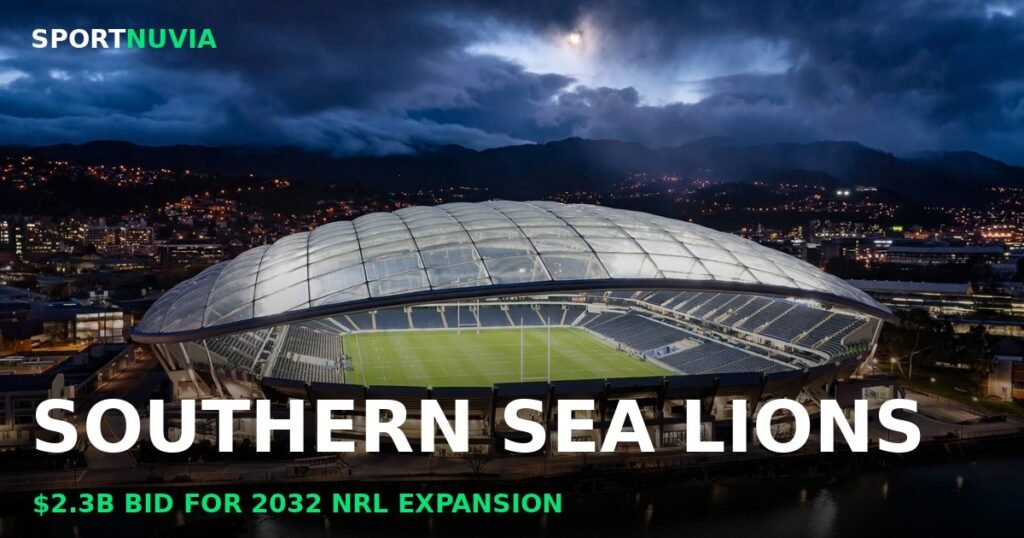
The Sea Lions would be based at Forsyth Barr Stadium, Dunedin’s fully roofed 30,000-seat arena, and would represent the entire South Island, drawing support from Otago, Southland and Canterbury. The consortium has already designed a club logo and a playing strip in maroon, gold, white and ocean blue, underlining that this is far more than a passing idea. Dunedin Venues chief executive Phil King has confirmed the approach, while the proposal has the backing of the city’s mayor and one of the most powerful financial groups in the region.
The move comes as the NRL’s expansion push gathers serious pace. The Perth Bears join as the 18th team in 2027, the Papua New Guinea Chiefs follow as the 19th team in 2028, and a 20th licence for 2029 is expected to be decided within weeks. Beyond that, V’landys has publicly flagged a second wave of expansion to 22 teams in the next broadcast cycle after 2030, and Dunedin wants to be at the front of that queue.
Southern Sea Lions: The Dunedin Bid at a Glance
The headline details of the bid are striking. The proposed club would be known as the Southern Sea Lions, a name drawn from the wildlife of the Otago coastline, and the consortium has moved early to build a complete identity, commissioning a logo and a playing kit in maroon, gold, white and ocean blue. Images of the branding obtained by Code Sports show a bid that has been in preparation behind the scenes for some time, rather than a reaction to headlines elsewhere.
Formally, the consortium has now contacted V’landys directly, putting Dunedin’s name on the ARL Commission’s desk at the very moment the game’s leaders are mapping out the long-term shape of the competition. The bid is targeted at entry in 2032, as a 21st or 22nd club, although reporting in New Zealand suggests the group believes it could be ready far sooner if the NRL accelerates its plans.
The New Zealand Herald reported that Dunedin is in talks to bring an NRL team to the South Island and could be ready to go as early as 2029, and put the value of the consortium’s backing at $2.8 billion. A wider South Island model could also see the team take selected home games on the road to centres such as Invercargill or Queenstown, spreading the benefits of a franchise across the whole of the south.
What the $2.3 Billion Figure Really Means
The eye-catching $2.3 billion number attached to the bid needs explaining, because it is not a transfer kitty or a one-off payment to the NRL. According to Code Sports, the bid is backed by a city-owned group with more than $2.3 billion in assets. That group is Dunedin City Holdings Limited, known as DCHL, the council-owned holding company that owns Dunedin Venues and, through it, Forsyth Barr Stadium itself.
In other words, the $2.3 billion represents the balance-sheet strength of the organisation standing behind the Sea Lions. It is a statement of financial muscle and long-term security: the consortium’s argument is that a club owned within a group of that size would never face the cash-flow crises that have haunted expansion franchises in the past. DCHL chair Tim Loan said the group had the financial clout to bankroll a 21st or 22nd NRL club.
“The strength of our group lets us explore this with confidence and look seriously at private investment,” Loan said. “I’m genuinely excited to see where it lands for the city and the south.”
That matters because the NRL’s price of entry is steep and rising. V’landys has repeatedly stated that new franchises must bring around $100 million of investment to the table, structured as a licence fee across five years, alongside proof of sustainable crowds, pathways and commercial support. Against those benchmarks, a backer with a multi-billion-dollar asset base starts the conversation from a position of rare strength for a regional bid.
Forsyth Barr Stadium: A Roofed Fortress in the Deep South
Every successful expansion bid needs a stadium story, and Dunedin’s is arguably the strongest in New Zealand. Forsyth Barr Stadium holds 30,000 spectators, has a fixed roof over a natural grass surface, and can host world-class sport in any weather – a genuine point of difference in a competition where winter nights in the deep south can be brutal.
The venue’s big-event CV is already proven. It hosted matches at the 2011 and 2023 Rugby World Cups, it is the home of Super Rugby side the Highlanders, and it is a regular venue for All Blacks Tests. Rugby league is also already coming to the stadium: it will stage an NRL premiership match between the Wests Tigers and the Warriors in April 2027, a fixture that will serve as a live audition for the city’s appetite for the 13-man game.
King is in no doubt about what a permanent team would mean for the venue and the city. “When a big event comes to Dunedin, the whole South Island turns up,” he said. “We’ve built a stadium that can host world-class sport in any weather, and a team of our own would fill it every winter. The Southern Sea Lions would give the south a team to call its own, and we’re building the case to make it happen.”
The People Behind the Bid
The bid is being driven by Dunedin Venues, the organisation that runs the stadium, with chief executive Phil King as its public face. King confirmed the approach to the NRL and stated plainly that the Sea Lions are ready for entry in 2032. Behind him sits DCHL, the council-owned group whose asset base underwrites the whole proposal, chaired by Tim Loan.
Political support has also fallen into line. Dunedin mayor Sophie Barker is backing the proposal, arguing that a franchise would accelerate the growth of a city already on the rise. “Dunedin is growing,” she said. “A world-class team representing a world-class city would take that to the next level, bringing visitors, investment and energy to the whole south. We’re so excited by what the Southern Sea Lions could become, and we want the whole south to get behind them.”
There is heavyweight promotional support too. Former New Zealand Test forward Dean Lonergan, the man behind the NRL Nines and a key figure in bringing the Warriors’ clash with the Tigers to Dunedin, has thrown his weight behind the bid, insisting the region cannot be ignored by the NRL. “Rugby league is exploding in New Zealand thanks to the NRL and its supremo Peter V’landys,” Lonergan said. “It’s a no-brainer to bring an NRL team to Dunedin.”
A Team for the Whole South Island
Crucially, the Sea Lions are not pitched as a club for one city of around 135,000 people. The bid is built on a regional model in which the franchise represents the entire South Island – a catchment stretching across Otago, Southland and Canterbury, from Invercargill in the far south to Christchurch in the north.
King points to the numbers. “The South Island is home to 1.26 million people but has no NRL team of its own,” he said. “By comparison, the North Queensland Cowboys play out of Townsville, a city of around 200,000, yet draw regular game-day crowds from a regional catchment of roughly 750,000 to 850,000 people.”
That Cowboys comparison is central to the pitch. Townsville’s franchise has become one of the NRL’s most reliable crowd-pullers precisely because it belongs to a whole region rather than a single postcode. Dunedin’s backers believe a South Island club could replicate that model, with Forsyth Barr Stadium as its fortress and occasional matches taken to other southern centres to bind the region together.
The sporting gap is real. The South Island has no NRL team, and its rugby league fans currently have to pledge their loyalty to the Warriors in Auckland or to Australian clubs. A Sea Lions franchise would instantly become the focal point for league across the south, and a natural rival for the Warriors in a New Zealand derby the NRL has long wanted to build.
Where the Sea Lions Fit in the NRL Expansion Timeline
To understand Dunedin’s timing, it helps to map out where NRL expansion stands. The competition currently has 17 teams. The Perth Bears, approved in May 2025 and coached by Mal Meninga, enter as the 18th club in 2027, restoring a Western Australian presence three decades after the Western Reds folded. The Papua New Guinea Chiefs, confirmed in December 2024 with $600 million of Australian government funding behind them, follow as the 19th club in 2028, based in Port Moresby.
The next prize is the 20th licence, targeted for entry in 2029. V’landys has said a decision is expected around Christmas 2026, although he has conceded it may slip into the new year given the volume of data to analyse. The race has become a straight fight between Queensland and New Zealand: Ipswich Jets, Brisbane Tigers, Logan, Toowoomba and Central Queensland are all in the frame for a fifth Queensland club, while Christchurch’s council-backed Southern Sporting bid and the Southern Orcas are leading the New Zealand push, with a decision underpinned by the league’s new seven-year, $5.3 billion broadcast deal starting in 2028.
Dunedin’s bid sits deliberately beyond that fight. The Sea Lions are not applying for the 20th licence. They are positioning for the wave after it – the move to 21 and then 22 teams that V’landys flagged last month for the broadcast cycle beyond 2030. That is why 2032 is the target date in the bid, and why the consortium has made its approach now: to be established in the Commission’s thinking long before those final two licences are allocated.
V’landys and the Road to 22 Teams
The most important voice in this story belongs to V’landys himself, and his recent comments explain why Dunedin believes the door is open. The ARL Commission chairman has made little secret of his ambition to grow the competition to 22 teams during the next broadcast cycle, and he sees New Zealand as central to that growth.
“There’s no doubt in my mind we will go to 22 teams in the next broadcast cycle,” V’landys said. “The game is going so strongly that I believe we will be in a position to have more teams. By having 22 teams, you can do a lot of things with the game. We can bring in conferences, and you can play around with the number of rounds to reduce the workload on players. The game has never been stronger in New Zealand thanks to the Warriors – it’s a region we are looking at for fresh expansion.”
That final line is the one Dunedin’s backers will have underlined. With the Warriors selling out stadiums across New Zealand and league’s profile at an all-time high, V’landys has effectively invited New Zealand bids to come forward for the expansion wave of the early 2030s, raising the prospect of two new Kiwi franchises eventually joining the Warriors. The Sea Lions are the first to answer that call in public.
Rivals, Risks and the Christchurch Question
None of this means Dunedin’s path is clear. The obvious complication sits 360 kilometres up the road. Christchurch has been the long-standing frontrunner for a second New Zealand team, with a new stadium at Te Kaha, a council-supported bid through Southern Sporting Ltd, and the Southern Orcas consortium – led by former Kiwis coach Sir Graham Lowe – also proposing a Christchurch-based club. If the NRL ultimately decides the South Island can sustain only one franchise in the next decade, Dunedin and Christchurch could find themselves in direct competition.
There are other hurdles. Player depth is the question raised every time expansion is mentioned, and a 22-team league would need roughly 660 top-grade players. Travel, junior pathways and the commercial market of a small city will all be scrutinised by the Commission. The bid also remains, by its own description, at an exploratory stage: formal contact has been made, but no licence has been granted, no application deadline has been announced for the 21st and 22nd licences, and a great deal of detailed work sits between a logo launch and a kick-off.
Yet Dunedin’s counter-argument is powerful. Unlike most bid cities, it already owns a finished, roofed, 30,000-seat stadium through the very group backing the team. It has a defined regional identity, political unity behind the proposal, and a balance sheet that dwarfs most rival consortiums. And by targeting 2032 rather than fighting Christchurch and Queensland for the 2029 slot, it has chosen the race it can realistically win.
What Happens Next
In the short term, attention stays on the 20th licence, with a decision expected around Christmas 2026 or early in the new year – that is late December in Australia and New Zealand, which is the same calendar window for fans following in Bangladesh. The April 2027 Tigers-Warriors match at Forsyth Barr Stadium will then give Dunedin a priceless opportunity to demonstrate demand in front of NRL powerbrokers.
For the Sea Lions specifically, the next steps are about building the detailed case: financial modelling, pathways structures, commercial partnerships and private investment to sit alongside DCHL’s public backing. If the Commission formally opens expressions of interest for the 21st and 22nd licences as the next broadcast cycle approaches, Dunedin intends to be ready on day one.
Frequently Asked Questions
1. What is the Southern Sea Lions bid?
The Southern Sea Lions is the name of a proposed NRL franchise based in Dunedin, New Zealand. A consortium from the city has formally contacted ARL Commission chairman Peter V’landys about joining the competition, with a logo and playing strip in maroon, gold, white and ocean blue already designed.
2. What does the $2.3 billion figure refer to?
It refers to the asset base of the bid’s financial backer. Code Sports reported the bid is backed by a city-owned group with more than $2.3 billion in assets – Dunedin City Holdings Limited (DCHL). The New Zealand Herald separately reported the consortium’s backing at $2.8 billion.
3. Who is behind the Dunedin NRL bid?
The bid is driven by Dunedin Venues, led by chief executive Phil King, and underwritten by council-owned Dunedin City Holdings Limited, chaired by Tim Loan. It has the support of Dunedin mayor Sophie Barker and promoter Dean Lonergan.
4. When would the Southern Sea Lions join the NRL?
The bid targets entry in 2032, as a 21st or 22nd club in a proposed 22-team competition. Reporting in New Zealand suggests the consortium believes it could be ready as early as 2029 if the NRL moved faster.
5. Where would the Sea Lions play their home games?
At Forsyth Barr Stadium in Dunedin, a 30,000-seat arena with a fixed roof and natural grass. The bid also raises the possibility of taking some matches to other South Island centres such as Invercargill or Queenstown.
6. Which areas would the Southern Sea Lions represent?
The whole of New Zealand’s South Island. The catchment stretches across Otago, Southland and Canterbury, a region of about 1.26 million people that currently has no NRL team of its own.
7. How many teams are in the NRL now, and how is it expanding?
The NRL currently has 17 teams. The Perth Bears join as the 18th team in 2027 and the Papua New Guinea Chiefs become the 19th team in 2028. A 20th team is targeted for 2029, and chairman Peter V’landys has flagged growth to 22 teams in the broadcast cycle beyond 2030.
8. Is Dunedin bidding for the 20th NRL licence?
No. The 20th licence, expected to be decided around Christmas 2026, is being contested by Queensland bids and Christchurch-led New Zealand bids. Dunedin is positioning for the following expansion wave, the 21st and 22nd licences.
9. What has Peter V’landys said about expanding to 22 teams?
V’landys has said there is no doubt in his mind the NRL will go to 22 teams in the next broadcast cycle, pointing to the strength of the game and the potential for conferences and a reduced player workload. He has also identified New Zealand as a region the league is looking at for fresh expansion.
10. What will it cost to enter the NRL?
V’landys has stated that new franchises must bring around $100 million of investment to the table, structured as a licence fee across five years, alongside evidence of sustainable crowds, pathways and commercial support.
11. Who are Dunedin’s main rivals for a South Island team?
Christchurch is the main rival. It has a new stadium at Te Kaha, a council-supported bid through Southern Sporting Ltd, and the Southern Orcas consortium led by Sir Graham Lowe, both proposing a Christchurch-based club.
12. Has Forsyth Barr Stadium hosted major events before?
Yes. The stadium hosted matches at the 2011 and 2023 Rugby World Cups, is home to Super Rugby’s Highlanders, regularly hosts All Blacks Tests, and will stage an NRL premiership match between the Wests Tigers and the Warriors in April 2027.
13. What stage is the Dunedin bid at now?
It is at an exploratory stage. The consortium has formally contacted the ARL Commission chairman and publicly confirmed its interest, but no licence has been granted and the detailed application process for the 21st and 22nd teams has not yet opened.
14. Would the Sea Lions rival the Warriors?
Yes, that is part of the appeal. A South Island club would create a genuine New Zealand derby with the Auckland-based Warriors and give southern fans a team of their own, without taking support away from the Warriors’ North Island base.
15. Why does Dunedin believe a small city can sustain an NRL team?
Because the model is regional, not city-based. Bid chief Phil King compares it to the North Queensland Cowboys, who play in Townsville, a city of about 200,000, but draw crowds from a catchment of 750,000 to 850,000 people. The South Island’s population of 1.26 million is significantly larger.
Conclusion
Dunedin’s Southern Sea Lions bid is the boldest statement yet that NRL expansion’s next frontier is New Zealand’s south. With a council-owned backer holding more than $2.3 billion in assets, a finished roofed stadium, a ready-made regional identity covering 1.26 million people and political support at every level, the bid ticks boxes that most expansion hopefuls can only dream of. The road to 2032 is long, Christchurch looms as a formidable rival, and the final decision rests with Peter V’landys and the ARL Commission. But by moving first and moving publicly, Dunedin has made sure that when the NRL sits down to draw its 22-team future, the Sea Lions will already be on the map.
